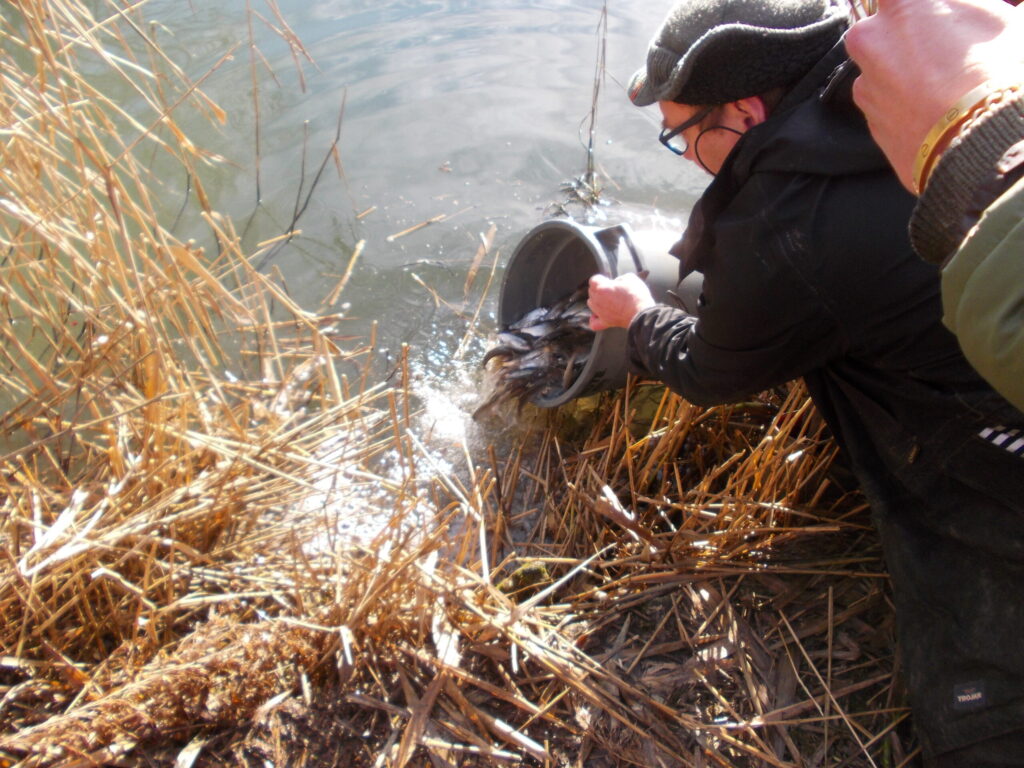
A partnership project to restore roach populations in the River Windrush has taken a major step forward with the arrival of 1,000 juvenile fish into a dedicated stocking pond within the catchment.
These young fish will play a vital role in the reintroduction and long-term recovery of roach in the Windrush, a species that has suffered dramatic declines in recent decades.
Roach are widely distributed across England, occurring in rivers, canals and still waters. Until relatively recently, the River Windrush was renowned for producing specimen roach, with individual fish regularly exceeding 1 kg in weight. Such were their abundance that, during the 1970s, Windrush roach were used to stock the River Thames. It is a sobering irony that this once-thriving species now needs to be actively returned to the river.
The causes of the roach’s decline since the 1970s are numerous and well documented, closely mirroring wider ecological deterioration within the catchment that has also affected species such as grayling and trout.
The primary driver of decline is the loss of their preferred spawning substrate, Fontinalis (commonly known as water moss or willow moss). This plant has been severely impacted by declining water quality, increased pollution and eutrophication. Where fontinalis has disappeared, roach recruitment has followed.
A range of additional pressures have compounded this decline. These include increased predation from avian species such as cormorants, as well as aquatic predators including invasive signal crayfish, which consume roach eggs and fry. Reduced abundance of aquatic invertebrates has limited food availability, while poorer water clarity has impaired the roach’s ability to feed effectively. Added to this is the cocktail of pollutants that have entered, and in many cases continue to enter, our rivers via sewage treatment works, agricultural inputs and road runoff. Research has even shown that roach living downstream of sewage outfalls can undergo genetic and physiological changes, with male fish developing female characteristics, an alarming indicator of the pressures this species is facing.
The Windrush roach recovery project began several years ago as a joint initiative between the Cotswolds Rivers Trust, the Cotswolds Flyfishers and the Environment Agency. Early work focused on the installation of artificial spawning boards, designed to replicate the conditions historically found near weir pools where roach would naturally have spawned on beds of fontinalis. This technique was first pioneered successfully by Trevor Harrop and Budgie Price on the Hampshire Avon. However, due to the very low numbers of adult roach remaining in the Windrush, these spawning boards have not yet delivered results.
The introduction of these new juvenile fish now offers an opportunity to accelerate recovery. Spawning boards will first be placed within the stocking pond, allowing them to become laden with roach spawn. Once eggs are present, the boards will be transferred into carefully selected sections of the river that still retain suitable habitat.
This process will be repeated over the next few years, supported by monitoring. Through this sustained and collaborative approach, the partners hope to rebuild a self-sustaining roach population, helping to restore a lost element of the Windrush’s natural heritage and allowing roach to once again reclaim their place in the river.